Theo Brennan
Editor

The best documentary YouTube channel ideas pair a subject people already care about with a public record that does most of your research and a visual route you can repeat every episode. Disaster and engineering forensics, aviation incidents, shipwrecks, corporate collapses, scientific fraud, speedrun records, defunct attractions and sports history all fit that description.
Pick the one whose grind you can keep up at about one video a month, because that is the pace the documentary channels still uploading actually manage. What keeps a channel alive is whether you can finish the next video.
You have probably also heard that every good topic is taken and that the fix is to go as narrow as possible. The numbers support neither half. Crowded subjects are not automatically badly paid, and narrow ones are not automatically well paid.
Note: How we researched this. We analysed 12,745 documentary-format channels to see how crowded each subject is and what a typical channel in it is estimated to earn, and 12,743 of them to see how often they upload. The set skews faceless, small-to-mid and English. We also read transcripts from 7 large solo documentary channels and went through 14 behind-the-scenes breakdowns in which solo creators explain where their visuals come from and which stage of the work is slowest.
How much work does one documentary video really take?
Plan for one finished video a month. That is the schedule the documentary channels still uploading actually keep, and most small ones have stopped uploading altogether.
What the channels actually do
We analysed 12,743 documentary channels for how often they upload. Of the 10,308 under 50,000 subscribers, 53% now average zero uploads a month. The active channels between 10,000 and 50,000 subscribers post a median of 1.08 videos a month, which is roughly one every four weeks.
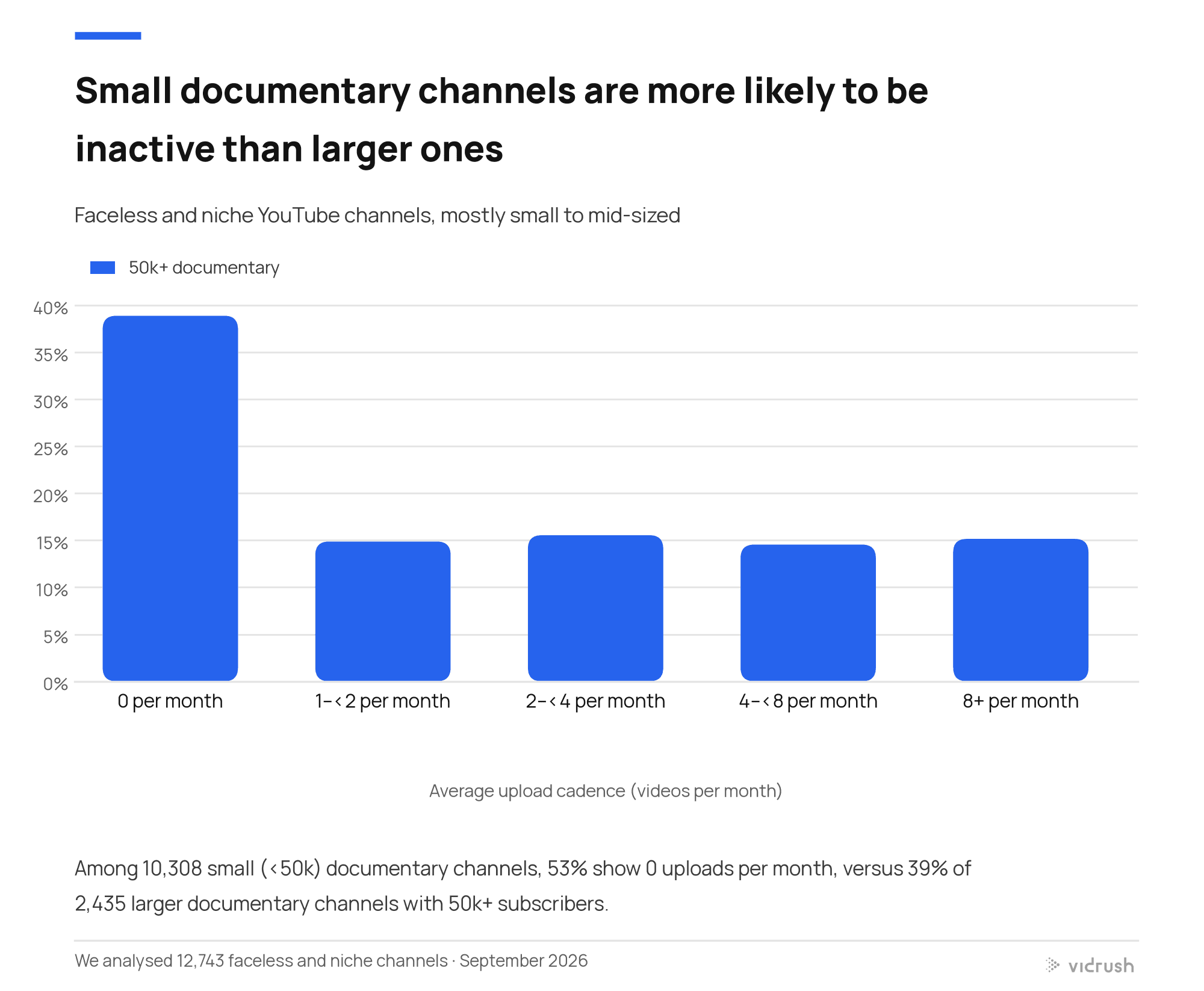
These figures do not tell you why those channels went quiet, and I would not guess. They do tell you what the survivors' schedule looks like, and it is not weekly. If your plan assumes a video every Sunday, you are planning against the channels that made it.
Where the hours go
A 15 to 20 minute documentary or video essay costs one person 20 to 80+ hours of work. A gameplay video costs 5 to 6. Those ranges come from creators comparing their logs in a r/NewTubers thread on real production times, so treat them as reported figures rather than a stopwatch. The gap still matters, because this format costs several times the hours of the channels you might be comparing yourself to.
Narration alone eats a day. Monty Zander, a video essayist with 100,000 subscribers, says a 15-minute section of script takes him a full day to record, once you count retakes, a tired voice and cleaning pauses in Audacity. He still calls editing the hardest part, because that is where script, voice, music and visuals have to be made to agree.
Most of what remains goes to research and visuals, and the subject you choose decides which of the two takes longer.
The schedule should follow the work. Rocky at FinAiUS researches, writes and narrates alone, outsources the 3D animation, and moved from weekly uploads early on to one video every eight weeks. I spent three years cutting 40-minute videos weekly for a UK channel with a team behind them, and I have never seen one person hold that pace alone for long.
Set your monthly hours budget first
Write down your real weekly hours. Use a normal week, not a good one. Count only the hours you would spend on the channel, not on watching other channels.
Multiply by four. That is what you have for one video. For example, 10 hours a week gives you about 40 hours a month.
Budget the first video at the top of the range. First videos run slow because every step is new. Plan it at 60 to 80 hours and be pleased if it comes in lower.
If the numbers don't fit, change the plan. A shorter runtime or a subject whose facts are already assembled will fit better. A promise of weekly uploads will not.
Documentary channel ideas, and what each one takes to make
Read each idea below with two questions in mind. Where will the facts come from, and where will the pictures come from? Those two answers decide most of your hours.
The shortlist
Subject | Reference channel | Where the facts come from | Where the pictures come from | Nearest category we analysed | Median estimated monthly revenue |
|---|---|---|---|---|---|
Disaster and engineering forensics | Accident investigation and Coast Guard reports, engineering diagrams | Its own record, plus diagrams you build | Engineering (364 channels) | about $7 | |
Aviation incidents | Crash investigation reports, cockpit and flight recorder transcripts | Built: crashes re-flown in a flight simulator from recorder data | Aviation (279 channels) | about $98 | |
Historical disasters | Public inquiry reports, newspaper clippings | Its own record: archival photos and clippings | No matching category | We had no category for this | |
Shipwrecks and ocean liners | Inquiry records, deck plans, period photos | Built: cutaways and deck plans | No matching category | We had no category for this | |
Corporate collapses | SEC filings, earnings reports | Its own record: old TV adverts, store photos | Business (184 channels) | about $6 | |
Scientific fraud | Retraction notices, inquiry reports, memos | Built: one reusable 3D look | Science (249 channels) | about $80 | |
Speedrun records | Leaderboards, split timers, forum archives | Its own record: gameplay | No matching category | We had no category for this | |
Defunct attractions | We did not trace its sources | Built where needed, such as its own queue simulation | No matching category | We had no category for this | |
Sports history | We did not pick one | We did not trace this | Its own record: broadcast archive | No matching category | Only a per-subscriber estimate (see note) |
True crime | Court records, seized chat logs | Its own record, where documents exist | Crime (1,138 channels) | about $85 | |
General history | Too many to single one out | Books and academic texts | Mostly built: maps, illustration | History (3,106 channels) | about $20 |
Counts and medians come from our analysis of 12,745 documentary-format channels: modelled estimates for a typical channel, not payouts, under the nearest category we had. Sports history had only estimated earnings per 1,000 subscribers (about $5.72, against $4.99 for aviation and $2.54 for history), a hint rather than proof.
Each reference channel shows what one subject looks like when someone does it properly. You do not need to watch them all. Read the pictures column first. That column describes the work you will be doing on an ordinary weeknight once the novelty has worn off, and if you cannot stand that work, you will stop uploading long before the subject runs out.
If you have under 40 hours a month and cannot draw, I would point you at historical disasters, corporate collapses or disaster and engineering forensics. The facts arrive already assembled in an inquiry report or a filing, and the pictures are mostly archive you cut rather than draw. If you already draw, animate or design, ignore that advice and look at shipwrecks or general history, where your skill does the work the missing footage can't.
Crowded does not mean badly paid
I expected the two big crowded categories, general history and true crime, to earn less per channel than the narrow ones. That was half right. Across the 12,745 documentary-format channels we analysed, history is the most crowded, with 3,106 channels, and has a median estimated monthly revenue of about $20. Crime has 1,138 channels and a median of about $85, which is close to aviation at about $98 and science at about $80.
Business, one of the narrowest categories, sits at about $6, and engineering at about $7, both well below crowded history. So narrow can pay, as aviation shows, but narrow does not pay by default.
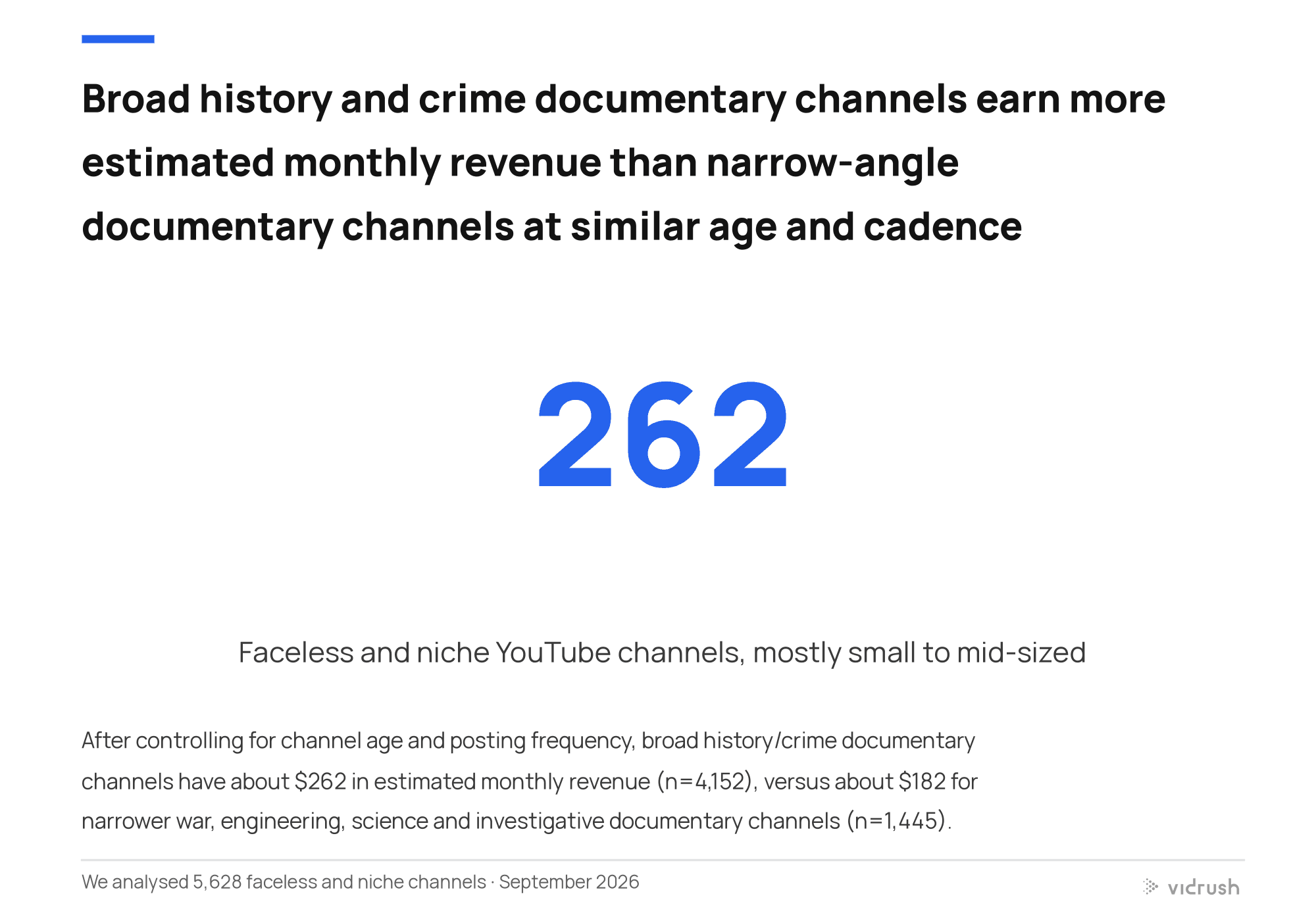
Matching channels on age and upload frequency pushed things further the other way. Across 5,628 documentary channels with both held roughly constant, the narrow group (specialised war, engineering and niche science) came in at an estimated median of about $182 a month, against about $262 for broad history and crime. Those medians sit well above the table's because it is a different set of channels, so compare them with each other, not with the table. Read together, the full set says crowding did not predict earnings, and the matched set says broad edged ahead. Neither gives you a reason to narrow by default.
Above $1,000 a month, the big categories look alike too: an estimated 18% of history channels clear it, 25% of crime, 29% of science and 20% of aviation.
A median describes the typical channel, not the ceiling. Business has one of the lowest medians, and Company Man still built 1.6 million subscribers on brand-decline stories, with uploads that reach 150,000 to 300,000 views within days. The low median tells you most business channels are small. It does not tell you the subject is dead.
Caveat: Crime earns, but think about which version you would make. I killed a crime channel after eleven videos because the good version needed victims' families and the cheap version was ghoulish, and I was making the cheap one. If you cannot explain your crime channel at a dinner table without wincing, pick another row.
Where the research comes from
Research load follows the paperwork. Accident investigators publish reports with exact timelines and causes, marine casualty investigations do the same for ships, and public companies file annual reports and bankruptcy papers. On those subjects you start from an assembled story and your job is to make it clear. Internet mysteries and deep history are the opposite: weeks in archived forum pages, dead links and academic books, with no timeline until you build one.
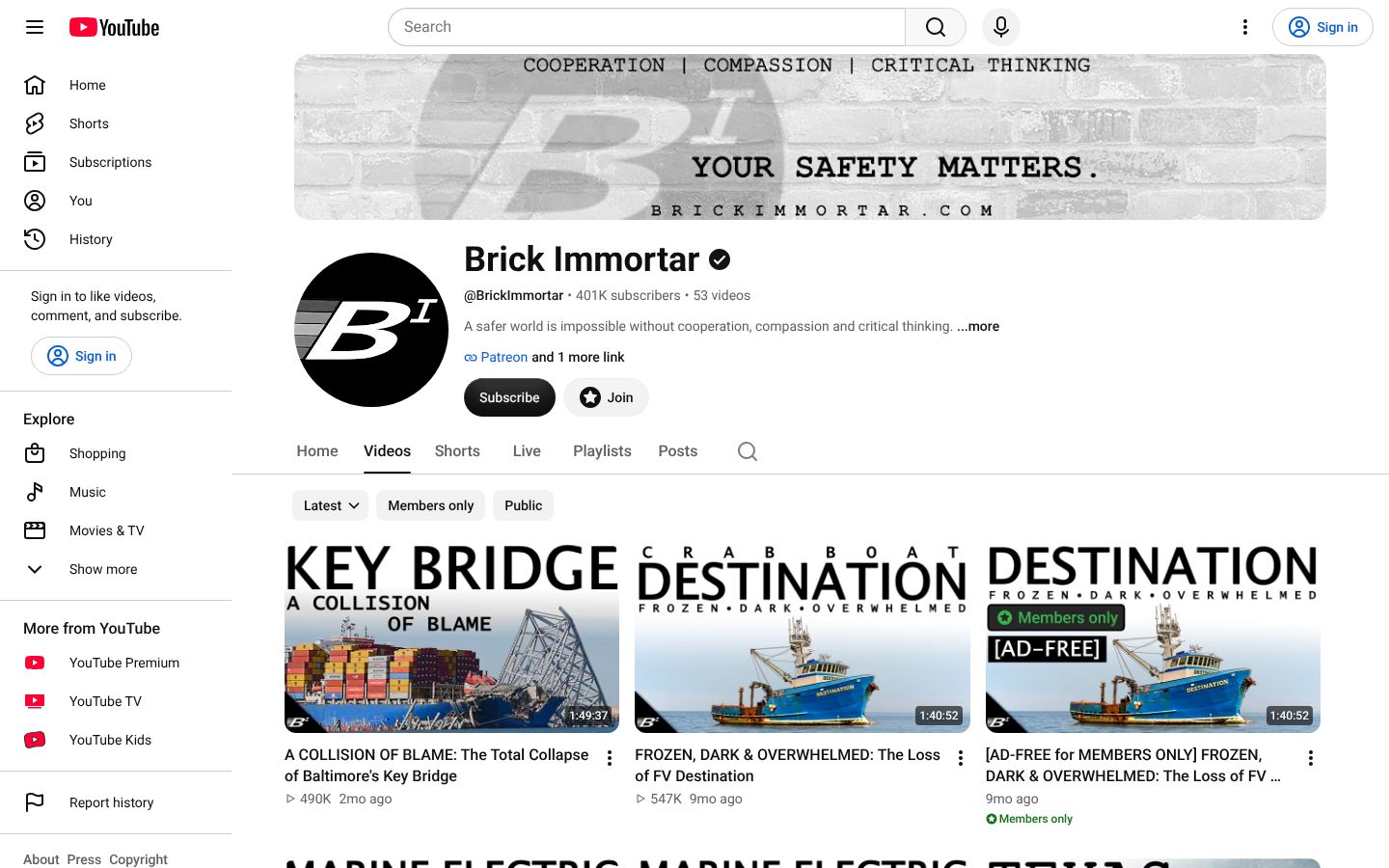
Brick Immortar is the cleanest example of the first kind. Each video starts from a published investigation, and the channel has around 400,000 subscribers, with 4.7 million views on its USS Thresher breakdown. The report hands over the facts, and the channel's work is turning schematics and recorder transcripts into something a normal person can follow.
Where your visuals will come from, and the tools that make it workable
Every subject in that table forces one of two routes: you cut the subject's own record, or you build the visuals yourself. In the creators' own breakdowns that we went through, everyone whose subject had rich footage used it, and everyone whose subject lacked it built a visual layer of their own. Nobody described stock filler as their main approach.
Neither route is the easy one. In the 14 breakdowns, visual work was named as the slowest or hardest stage on both sides of the footage line. One creator whose subject had little or no footage named making graphics, and among creators with rich footage, one named sourcing visuals and another named editing.
Half of the 14 never said which stage was slowest, and the sample leans towards map channels, so read this as a pattern in a small group rather than a measurement. It also says nothing about which route grows a channel faster. It is still enough to drop the idea that a subject with footage edits itself.
Route | Slowest stage | Hours reported by named creators |
|---|---|---|
The subject filmed itself | Finding the right clip, then editing | troyoboyo17: editing is about 90% of his time. The Nth Review: six months on one five-hour review |
No footage, so you build it | Drawing maps or graphics, and for some creators research | Eastory: about 20 hours drawing one base map. Possible History: about 10 hours per average video |
You present on camera | Research and scripting, then recording | Dr. Sean Munger: 5 to 6 weeks per video |
Three solo routes and where the time goes. Hours are what named creators report for their own channels, not benchmarks.
If your subject filmed itself, the chore is finding the shot
If you cannot draw or animate and do not want to learn this year, put subjects that recorded themselves at the top of your list. When we read transcripts from large channels, the clearest cases were internet crime, 2000s pop culture and televised sport. Barely Sociable's darknet video runs on seized chat logs and court material, and a Mandy Moore deep dive runs on MTV and talk-show archive.
You need less kit for this route than you think. Fascinating Horror built 1.4 million subscribers on calm narration over public-domain photos, newspaper clippings and inquiry reports, with no music and no animation. If your subject left an inquiry report and a stack of photographs, a steady voice and a folder of scans is enough to start, and I would not spend money on anything else until you have shipped three.
The footage still has to be found and cut, and that is where the hours go. troyoboyo17 makes film essays from Blu-ray rips of the films he talks about, so the footage could not be closer to hand. He still calls finding clips "easily the most time-consuming part of the process" and says editing takes roughly 90% of his time. The Nth Review records all of his own gameplay and still spent six months on one five-hour review.
Beginners run into this in their first week. One r/NewTubers creator cutting a 10 to 15 minute documentary says finding B-roll for a single minute that "actually fits the narrative takes me hours". That is one person's account, and it matches what I saw in edit bays for years. The script names a specific aircraft, year and airport, and a generic shot of a plane is worse than nothing, because viewers catch the mismatch.
So a subject that filmed itself turns the grind into hunting and cutting, and it is still a grind. It does get easier inside one subject area, which is my main argument for staying in one. Log every usable clip the day you find it, with the date, the source and what it shows. By episode ten you are searching your own folder before you search the internet, and a channel that jumps between subjects never builds that folder.
If it didn't, the chore is drawing
Subjects that left no footage get their pictures built, and the channels that do it well each settled on one kind of picture they can make again:
Cutaways and deck plans are how Oceanliner Designs replaced missing footage, and they became the channel's look.
One reusable 3D look carries BobbyBroccoli, whose scientific fraud serials dress paper records in the same stylised terminal style every time.
Simulator re-flights are the aviation answer: crashes with no footage get flown again in a flight simulator from the recorder data, with the flight data shown on screen.
Eastory runs a military history channel with over 400,000 subscribers on free software only. He aligns old topographic map sheets in GIMP (about 2 hours), hand-draws the rivers, forests, roads and front lines onto layers (about 20 hours), and animates the units in Blender. He records narration on a phone and cleans it in Audacity. The software costs nothing, and the drawing takes 20 hours.

The small version of this route is more encouraging. Possible History, a solo alternate-history channel with 10,566 subscribers, also works on free software. It puts an average video at about 10 hours and calls map preparation the longest, most tedious phase. What stops people on this route is tedium, not budget.
If you go this way, pick one visual format and repeat it. Every new style is a new set of problems to solve on deadline, and a format you have drawn twenty times is one you can still draw when you are tired. I would not worry much about being boxed in, because viewers come back for the question the channel asks, and the look turns into a signature.
Keep the first-year version modest. LEMMiNO, a large channel, builds custom diagrams around real artifacts such as the Pioneer plaque. One diagram style like that, learned properly, is realistic in your first year. Motion design at his level is not.
Some channels skip visuals almost entirely. Fall of Civilizations grew large on subjects with almost no visual record and introduces itself as a podcast. None of the creators whose breakdowns we went through ran that way, so I would only plan around it if your writing and your voice are already the strongest things you have.
On camera, the chore is research and your voice
Dr. Sean Munger, a historian, takes 5 to 6 weeks per video from topic to upload. His Pan Am documentary took 7 to 10 days of reading bankruptcy court records, about 7.5 days writing eleven chapters, and two 6-hour days on camera that left him hoarse. At that pace one person tops out at around 10 or 11 videos a year.
Appearing on camera does not get you out of visuals either. He marks up the printed script with sticky notes for every photo and piece of B-roll, builds aerial flyovers in Google Earth Studio, and then assembles it all in DaVinci Resolve. Take this route because you want to present, and do not expect it to save hours.
Hiring an illustrator moves the bottleneck
The creators with the most elaborate visuals had help. Among creators whose subjects left only a partial record, the median team was 2.5 people. In each of the other groups it was 1.0, and the creators in that partial-record group were the ones who named research as their slowest stage. Cogito has every character illustrated from scratch by a dedicated illustrator and still calls research "by far the most time-consuming phase". TheImperatorKnight pays a graphic designer and an editor, and his research notes still run for months.
I would not hire anyone in your first year. You don't yet know which stage you'd happily pay to lose, and paying someone for visuals just puts the next slow job in front of you sooner. Hire once the angle has held up past your first review and you can name the task that is costing you uploads.
A free stack is enough to start
Editor: DaVinci Resolve, free. No watermark, exports up to 4K at 60fps, with audio clean-up and colour built in. Studio is a one-time $295 if you ever outgrow it.
If you'd rather use Adobe: Premiere Pro at $22.99 a month on the annual plan billed monthly. It is subscription only, with a 7-day trial.
Stock footage: Storyblocks Essentials at $21 a month, billed annually, so $252 up front. There is no month-to-month option.
AI voice: ElevenLabs from $6 a month for commercial use, or $22 for the Creator plan with about 50 minutes of narration.
Audio clean-up for your own voice: Audacity, free.
Buy nothing until episode one is finished, because the first video shows you which gap actually hurts. On a subject with a public record, much of what you need is free archive and documents, and stock should only fill the gaps between them.
If you use an AI voice, write for it
Keep the script yours. The research and the structure are the documentary, and a voice tool only reads out what you give it. One creator who tried hundreds of prompts for documentary scripts kept getting short scripts with "robotic narration, no real story arc". Those are the two faults I would fix first in any cut. Write the full draft yourself, read it aloud once, and mark every sentence you stumbled on, because the voice will stumble there too.
A raw synthetic read is the first thing I would fix in anyone's cut. One creator describes spending 48+ hours on a video and watching "viewers immediately dismiss it because of the voice", which is one person's experience and a cheap mistake to avoid. Platform rules on AI narration change often, so we keep them on our page on YouTube's AI content policy. The prep below takes an hour or two per script:
Spell out numbers and years. Write "nineteen eighty-two", not 1982, and expand every abbreviation.
Mark the pauses. Use a full stop or an ellipsis where the story turns, so the viewer has a second to read what is on screen.
Generate a paragraph at a time. Listen to each one and regenerate the flat ones before you move on.
Import the finished audio into your editor first. It gives the cut its timing, so it goes down before any visuals.
Where VidRush fits, and where it doesn't
I work at VidRush, so weigh this accordingly. If your subject has real footage online and your hours disappear into hunting clips and lining them up against narration, VidRush takes over that stage and builds the cut from your script.
You paste your finished script, prepared the same way as for any AI voice, or upload your own narration. Before anything is generated it shows you the plan (format, length, voice and estimated cost) so you can change what's wrong. It then renders in the cloud in about an hour and returns a 6 to 40 minute documentary with narration, music and captions, matched to licensed stock, public-domain and web footage. Expect that first cut to be about 80% finished, with the rest done in its editor: swap clips, retime shots, fix captions, re-render.

Plan for the editing pass. On a story about a specific plane, ship or building, I would expect to replace some clips with exact archive you have found yourself. VidRush does not choose your niche or your angle, and this page assumes you paste your own finished script, so the thinking behind the channel stays with you. It is the wrong tool for map animation, illustrated history from before cameras existed, and 3D animation.
Starter is $99 a month for about 36 minutes of video, and Creator is $239 a month for about 110 minutes. There is no free tier or trial, and access is by waitlist or invite; the details are on VidRush pricing. So make episode one by hand first and write down where the hours went. If hunting for clips and assembling the timeline was the stage that hurt, and your subject has real footage, that is the point where it is worth pricing up.
Cut the table down to two or three subjects
Cross out every visual route you would not do monthly. If the thought of drawing a map for 20 hours makes you tired now, it will stop you in month four.
Cross out unstructured research if your monthly budget is under 40 hours. Subjects with a published report behind each episode fit small budgets far better than subjects you have to piece together.
Read the revenue column for surprises, not for a winner. A subject you will keep making beats a higher median you will abandon.
Keep two or three rows. One is too few to compare angles, and five means you have not decided anything.
How to turn a subject into an angle that won't run dry
If aviation or crime already feels taken, keep the pool of stories wide and make the question you ask of them specific. A channel that only covers one ship, one war year or one brand has a fixed number of videos in it. A channel that asks the same sharp question of a whole subject area can keep going for years, and the question is what makes it yours.
The category comparison earlier is the evidence against shrinking the list of stories you are allowed to tell. It compares subjects, though, and does not test angles, so nothing in our numbers proves that a sharp angle pays. That part comes from watching which channels stand out in crowded subjects, which is a pattern rather than a measurement.
An angle is one question you ask every story
A subject is what a video is about. An angle is the question every video answers. Beginners mix the two up constantly: they say their channel is about maritime history, which is a shelf in a library and gives nobody a reason to subscribe. The channels that stand out in crowded subjects each ask one recurring question across a broad run of stories.
Why did it fail, mechanically? Brick Immortar asks it of ships, submarines and structures, so any engineering disaster is fair game.
Who faked it, and how did nobody catch them? BobbyBroccoli asks it of physics and research institutions, which turns dry science into a fraud trial.
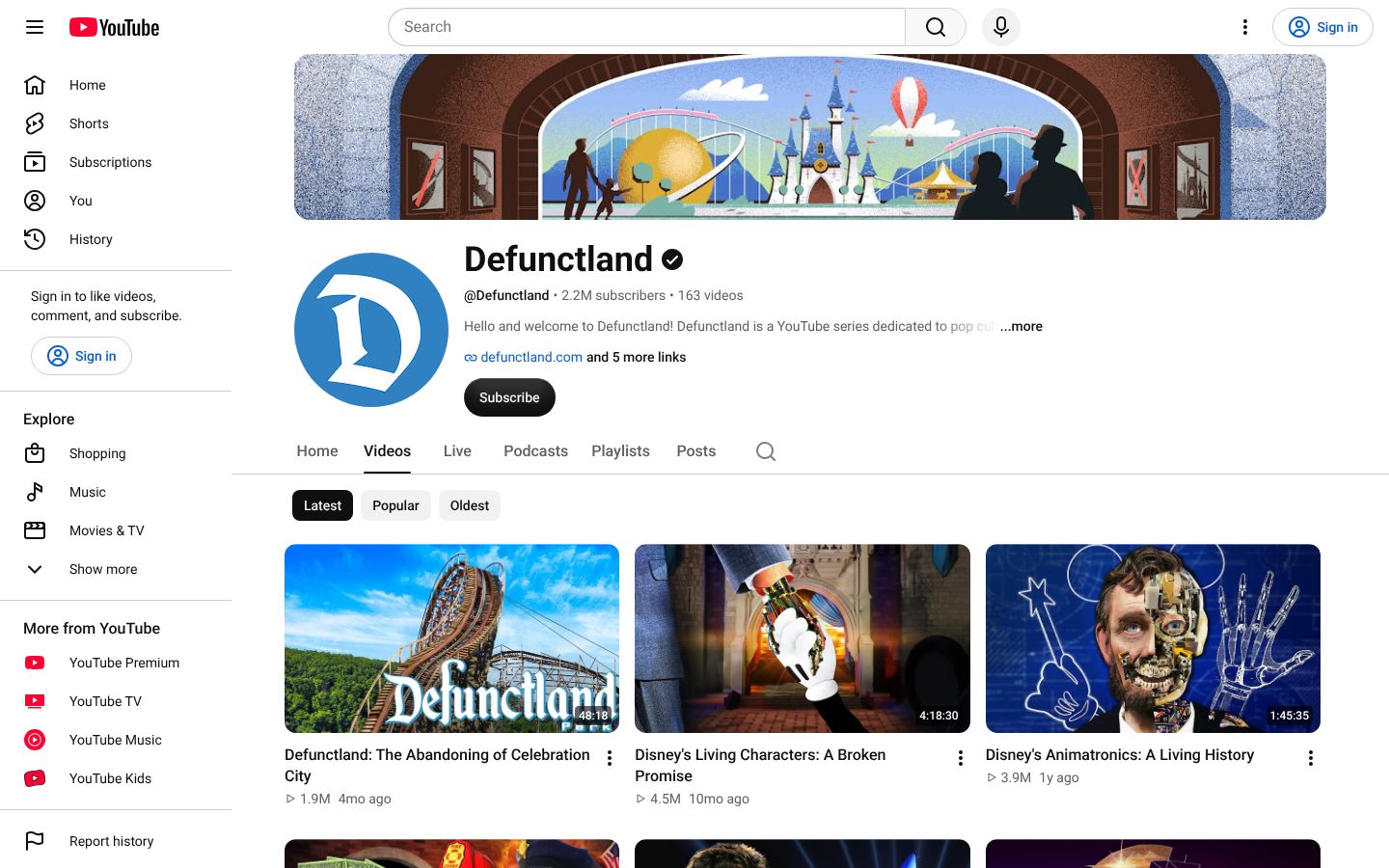
How did an ordinary system break? Defunctland asks it of theme park rides, queues and forgotten attractions.
How did this record fall? Summoning Salt asks it of speedruns, one game after another, as a race told in order.
None of those questions is tied to one event, which is what gives them runway. The same question works on the Titanic and on a ferry you have never heard of, and a viewer who liked the first episode has a reason to click the second even if they do not care about its subject yet.
That is the check I would run on any angle: would someone who loved video one watch video two on a topic they have never heard of? If the answer depends on them already liking the topic, what you have is still a subject.
Make a stranger care in two sentences
The subject can be tiny if the stakes are human. Defunctland's video on Disney's FastPass is, on paper, about a ticketing system. It has 27 million views, and it got them because it is a story about crowds, waiting and a company trying to engineer patience; told as ticketing trivia for park regulars, it would have stopped at park regulars. The channel even built its own queue simulation to show it.
So try this before you write anything. Explain the central conflict of one planned episode in two sentences to someone with no interest in the subject. If they lean in, the angle has a way out of its niche, and if the only hook is a neat technical fact, expect the audience to stay small. I have had plenty of creators pitch me a topic in ten minutes of detail; the ones that worked could be pitched in two sentences.
When your background is the angle (and when it isn't)
Some angles come from what the creator already knows. Mentour Pilot is run by Petter Hörnfeldt, a working Boeing 737 training captain, and he explains crashes through cockpit procedure and crew decisions, which outsiders cannot fake. Oceanliner Designs, the cutaway channel from the visuals section, exists because Mike Brady trained in industrial design, and that training solved the problem of liners that sank before anyone filmed them properly.
You do not need either. Brick Immortar, BobbyBroccoli and Summoning Salt all built their angle from a question and public records rather than a job title. If you have a skill that makes a subject easier to explain or easier to show, use it. If you do not, pick a question you are curious enough to ask 30 times.
Count the episodes before you commit
Aim for twenty to thirty episodes, because at one video a month that is roughly two years of work. It is enough to know whether the angle lands, and it is a list you can actually check, unlike the hundreds of casual ideas generic advice tells you to brainstorm.
Write the angle as one sentence. Subject plus the question, for example: "Why corporate icons collapsed, told from their own filings."
List 20 to 30 specific episode titles. Named events, companies or people, not themes. Do this before you touch a logo or channel art.
Find the public record for each one. An investigation report, court filing, company filing, archived press or leaderboard. If you cannot find it after a genuine evening of looking, cross the title out.
Note where the pictures come from for each survivor. Use the two routes from the visuals section: the subject's own record, or visuals you build.
If fewer than 20 survive, widen the pool of stories and keep the question. "Why British airlines failed" can become "why airlines failed" without losing the angle.
Tip: Put the three most famous stories in your list aside and count what is left. Those three will be your easiest videos and your biggest early views. The channel lives or dies on whether the next 20 are still worth making.
What running out looks like
Company Man is the case I would show anyone skipping the count. In the creator's own eight-year retrospective, he describes covering the obvious collapses (Blockbuster, Toys "R" Us, Kmart) within the first 100 or so videos, on a schedule of about 54 uploads a year.
After that he built a site to crowdsource ideas and rationed the big brands across years, Pepsi one year and Coke the next. Annual views fell from a peak of 60 million to under 10 million as viewers commented that the channel was running out of topics.

That is the creator's own account, and plenty else changes over eight years, so read it as one channel's story rather than a law. The shape is still the warning. Company Man's question was tied to famous brands, and famous brands are a finite list. At one video a month you will take far longer to reach that wall, but it is the same wall, which is why the angle should be a question that works on the obscure cases too.
Will people watch it, and what will the views pay?
To check demand, look at what YouTube already recommends, because keyword tools won't tell you much. People rarely search for a shipwreck before watching a video about one; they find it on their home page or beside another video. DecodingYT estimates that 80 to 90% of long-form storytelling views come from those browse and suggested feeds. That is his estimate, not a platform figure, but it explains why an idea with near-zero search volume can still reach a large audience.
The checks below use what is visible on YouTube itself, cost nothing, and fit in one evening before you spend 50 hours on a script.
Four free checks before you script
Find small channels beating their size. Search your subject and pick 3 to 5 channels under 10,000 subscribers. Look for videos pulling two to ten times their subscriber count. That is one faceless-channel operator's demand check, and his rule for failing it is plain: if every small channel is stuck under 500 views, walk away.
Count who has already told your exact story. If more than three videos on the same premise passed 20,000 views in the past 12 months, re-angle. If the top videos on it are over six months old, there may be room for a fresh or deeper take. That is one creator's filter, posted on X.
Read the top comments. Open five of the best-performing videos on the subject, sort comments by Top, and write down the questions nobody answered. One of those questions can become an episode.
Sketch the thumbnail and write the title. Draw one image a stranger would understand in three seconds, and write a title under 50 characters about the conflict. If you can't, the premise isn't ready to script.
Borrow the premise of an outlier, not the story
When a modest channel's video does 5 to 20 times its usual views, the hook travels beyond its fans. A ViewStats breakdown of outliers points to Reality Buzz, a channel that normally gets 1,000 to 3,000 views, reaching 675,000 with a video on why everyone hates one MasterChef contestant. Copying that story adds one more video to a pile that already exists. Take the structure instead (a figure everyone dislikes, finally explained) and try it on a case from your own subject.
What the checks can't tell you
These checks show that people watch a kind of story. They can't show that people will watch your version of it, or how long they'll stay. I treat a fail on the first check as a stop, because nothing you do in the edit fixes a topic that small channels can't get views on. A fail on the other three means re-angle, which is cheap to fix at this stage and expensive once the script is written.
How many views income takes
Work it out from RPM, the revenue a creator receives per thousand views. Two real figures mark out the range. Chris Barrera's on-screen analytics show a 17-minute police bodycam documentary at 1,849,791 views, $7,869.91 and a $4.26 RPM. At the low end, a small history channel's creator reported that 247,000 views in its first monetised year paid £371.23, about $480, which works out to an RPM of roughly $1.95.
Those are one creator each, one shown on screen and one self-reported. In our comparison of 5,628 documentary channels matched roughly on age and upload frequency, the estimated median RPM was about $2.60 for narrow categories and $3.30 for broad history and crime. Both fall between the two creators' figures, so the range is a fair basis for the arithmetic.
Monthly revenue target | Views needed at $1.95 RPM | Views needed at $4.26 RPM |
|---|---|---|
$100 | about 51,000 | about 23,000 |
$1,000 | about 510,000 | about 235,000 |
$10,000 | about 5.1 million | about 2.3 million |
Arithmetic from two creators' reported RPMs. It shows the view scale behind each target and is not a forecast for any channel.
So $1,000 a month takes somewhere between about 235,000 and 510,000 views a month, and $10,000 takes roughly ten times that, in the millions every month. At one upload a month, that total has to come from your whole back catalogue, not just the new video. Only a minority of the documentary channels we analysed are estimated above $1,000 a month, which is why I'd plan year one as the year you learn the craft and build that catalogue.
RPM also depends on who is watching. Barrera's advice is to check that your audience is mostly 25 and over, because adults with money to spend are what advertisers pay for. It is why I check who the audience is before I get excited about how many of them there are: a million views from the wrong people can pay less than a few hundred thousand from the right ones.
Your first video, and when to change course
Make episode one a story most people have already heard of, told through your angle. Then commit to five to ten uploads before you judge the concept. If none of them gets picked up, change the angle or the title and thumbnail, because uploading more of the same will not help.
Start with a story people already know
A familiar subject leaves only one thing to test. The topic is not in question, so if people click and stay, my reading is that your angle is what held them. Company Man's video on the decline of Kmart and Fascinating Horror's Luna Park video are built this way: each takes a name most people have heard of and tells that story in the channel's own way.
You already have candidates. When you counted your runway, you set aside the three most famous stories, so spend one of them now. I would space the other two across your first five or six uploads rather than running them back to back, so each stretch of lesser-known episodes has a familiar story near it to compare against.
A name people recognise. The brand, disaster, record or scandal should be one a stranger has heard of.
Your question in the first minute. If the angle does not show up early, you are testing the topic, and other people have tested that already.
A complete public record. Episode one should not also be your hardest research job, because you will already be slow at every other step.
Your normal visual route. Episode one should look like episode ten. Do not build a one-off style you cannot repeat monthly.
How many uploads before you know
Fewer than most advice suggests. We analysed 11,541 documentary channels that reached at least 1,000 subscribers and looked at when each first showed meaningful traction, meaning a clear jump in how its videos were picked up. For 48.2% of them, the jump came by the second upload. Another 24.7% got there between uploads three and five, so 72.9% showed it within their first five. Only 2.3% needed more than 50.
Caveat: These are the survivors. Channels that never got that far are not in the count, so it cannot tell you your odds of making it. It does show that the channels that made it rarely took a hundred uploads to show a first sign, and "upload 100 videos and wait" does not describe them.
A slow schedule does not rule you out either. YouTube's creator team says in its explainer on recommendations that view growth is not tied to how often a channel uploads, and that subscriber count does not decide how fast a video picks up views. Take them at their word and a small channel posting once a month is still in the running. I would rather you post one finished documentary a month than four rushed ones, because the rushed ones are the ones that make people quit.
So set your review at five to ten uploads, which at one video a month is five to ten months away. Put the date in your calendar before you start the script, so the review happens on a day you chose in advance and not on the day you feel worst about the latest upload.
If nothing moves, change the angle or the packaging
At the review, check whether any upload is being shown on viewers' home pages and beside other videos, and whether one or two are clearly beating the rest. If none of five to ten focused uploads has any of that pickup, the angle probably does not fit this audience, and the number of uploads is unlikely to be the problem.
I learned that the slow way. In 2021 I ran a Spanish-language list channel with enormous views that never became a business, and I lost most of the year telling myself the next upload would break a pattern that turned out to be structural. Another upload of the same bet mostly tells you what the last one did.
Change the packaging first. Rework the titles and thumbnails of your two strongest episodes, because that is the cheapest fix and needs no new footage.
Then change the question. Keep the subject and the research habits you have built, and ask a sharper or more human question of the same stories.
Change the subject last. Only if the runway count or the demand checks no longer hold up, and only after you have worked through why a faceless channel stops growing.
Before you make episode one
Two jobs sit between this page and your first upload. The first is setting up the channel, which should take an evening. The second is writing the script for episode one, which will take much longer and deserves the time.
By now you should be able to say your channel in one sentence: a subject, the question you ask of it, and where your pictures come from. Write episode one's title at the top of your runway list and the review date underneath it. Nobody can tell you in advance whether the angle lands, and the review after five to ten uploads is where you find out.

Pick a documentary subject whose public record already holds the facts and whose visuals you can produce the same way every time. Then plan for one finished video a month, because creators report 20 to 80+ hours for a 15 to 20 minute documentary. The usual mistake is shrinking the topic to stand out: in the 12,745 documentary channels we analysed, crowded crime had about the same estimated typical earnings as narrow aviation, and narrow business and engineering had the lowest.